
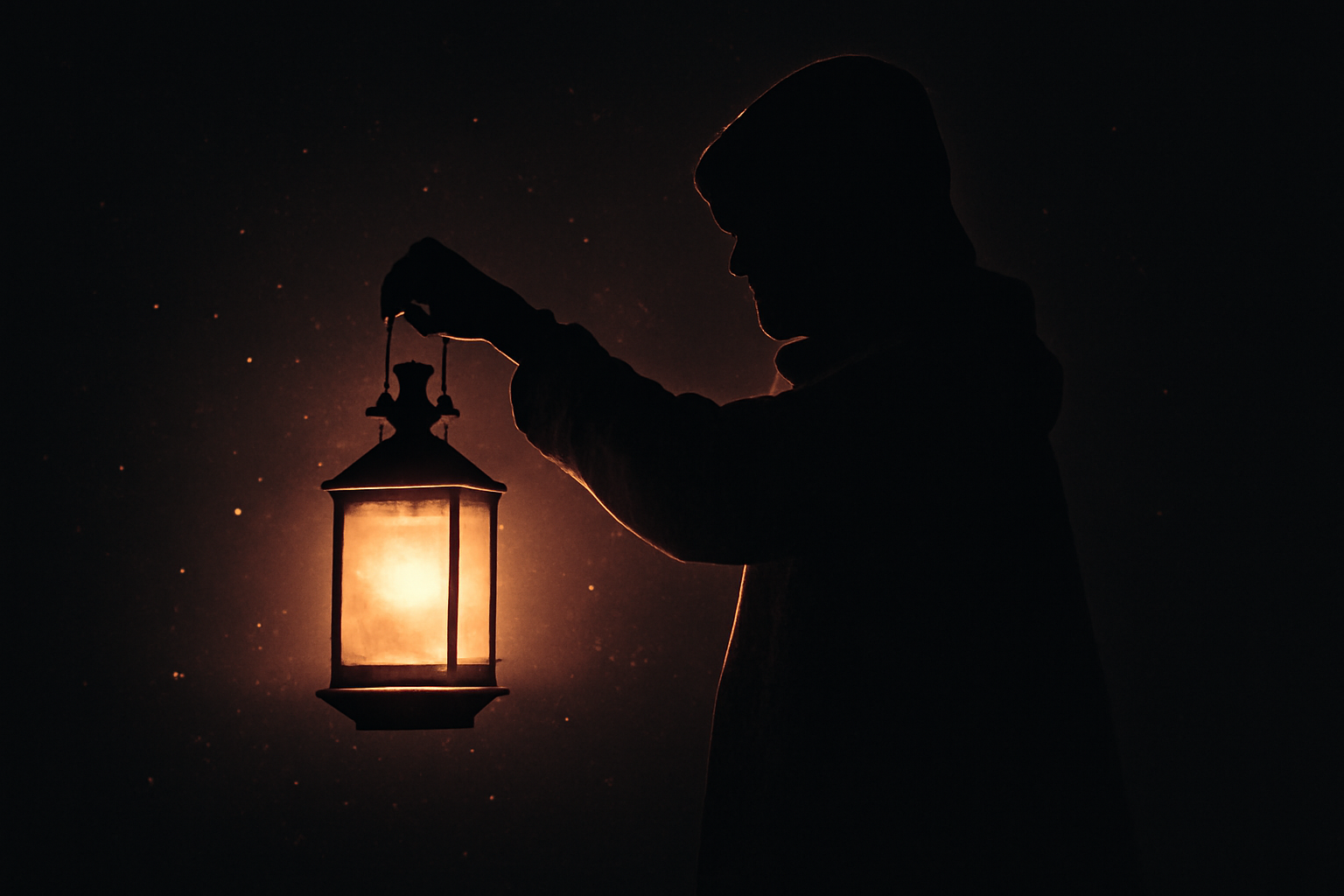
You are standing at the kitchen sink, doing the washing-up — that humblest of meditations, in which the warm water and the small repetitive motions seem almost designed to loosen something held tightly elsewhere — when a song from your childhood drifts in from a radio in a neighbouring flat, or perhaps merely from somewhere inside the loose archive of memory; and quite suddenly there is a sensation in the chest you cannot quite name, neither sadness exactly, nor joy exactly, but something older than either, a soft and undefended pulling, as though some long-dormant part of you had just stirred awake to see who was home.
It is, I suspect, the small self — the child you once were — asking, in her own quiet way, for something. And the only question that really matters, then, is whether you are willing to listen long enough to hear what she is asking for, given that no one, in all probability, has asked her in a very long time at all.
We tend to be embarrassed, in our adult lives, by the very notion of an inner child; it sounds soft, perhaps even faintly sentimental, the kind of phrase one might find emblazoned on a fridge magnet somewhere between a hummingbird and an exhortation to dance like nobody's watching. And yet, however much we should rather like to outgrow her, there remains in each of us something undeniably small — something that feels things at the scale of a small person, that wakes at three in the morning frightened of the dark, that is unaccountably wounded by something said at dinner that no reasonable adult should still be wounded by. Might it be — and I want to ask this with the gentleness the question deserves — that her continued presence is not, in fact, a flaw to be eradicated, but a faithful inhabitant of you who has, all your adult life, been waiting for someone at last to ask her what she actually wants?
You may find her requests surprisingly modest, when they first surface; she does not, you may notice, ask for a holiday or a new career or any of the large grown-up consolations we tend to offer the soul as substitutes for what it actually needs. Her requests have the size of small-person requests, easily mocked by an uninvited interior voice if one is not careful — she might want, for instance, that you eat a proper lunch sitting down at a table rather than standing at the kitchen counter at half-past two while answering emails; she might want you to put on a jumper because you have, in fact, been cold for half an hour and have been ignoring it; she might want to go to bed at an unfashionably early hour, with a book and a hot drink and no plan whatsoever for the morning. And one is forced to wonder, on hearing such requests, how long it has been since one has granted her any of them, and whether the long refusal of such small dignities might, in fact, have something to do with the strange Sunday-evening hollowness one had attributed to other causes entirely.
There is a particular and rarely-named cruelty in the way many of us treat our own tenderness — we treat it as an enemy of productivity, as an indulgence to be overcome, as an embarrassing remnant of an earlier and weaker self; and we then call the overcoming of it "maturity", which is, when examined, one of the more efficient swindles modern adulthood performs on the people who attempt it most diligently. The inner child is not, after all, the irresponsible sibling of the responsible you, hoping to dismantle your career and your obligations; she is the part of you who knows, with a precision the busy adult mind has rather lost touch with, what actually soothes you, what makes you feel safe, what genuinely refills the well — as distinct from what merely numbs you for a couple of hours and leaves you, in the morning, fractionally worse than you were before.
What does she find genuinely soothing? It is, I think, worth pausing on the question, because the answer is rarely what one would have predicted. It is rarely the glass of wine, or the long scroll, or any of the consolations we reach for instinctively. It is, more often than not, something one would call silly — watching rain through a window without trying to do anything else at the same time, walking somewhere with no particular destination, sitting on the floor instead of a chair, being read to aloud, laughing until one's stomach hurts at something genuinely ridiculous, drawing badly on a piece of paper one has no intention of showing to anyone. When was the last time you laughed in that particular way, the way that leaves you a little breathless and slightly silly afterwards? When was the last time anyone read aloud to you? If those questions ache, even a little, I suspect that is her speaking — reminding you, with the patient clarity of small people, that the cures are sometimes very simple, and that we have been making the mistake of looking for complicated ones.
A more compassionate adulthood, then, is not — and I want to be careful here, because the idea is easily misunderstood — about resigning one's grown-up responsibilities or abandoning the work of being a competent person in the world; it is rather about adding her back into the conversation, about consulting her gently before making plans, about asking, on a Saturday morning, not the usual "what should I be doing?" but the much rarer and stranger "what would you like to do today?" She may not answer at first; she has been ignored for a long time, and she will probably be wary, and you may need to spend a few weeks sitting with her in companionable silence before she trusts you enough to speak at all, which is no more than you would offer any small person you had not seen in years.
There is, finally, the question of what she most particularly does not want — and it is worth knowing, because we so often deliver it to her without thinking. She does not, please, want to be lectured by the harsh interior voice that scolds you when you fail; she does not want to be dragged through another conversation in which you are unkind to yourself in the mirror; she does not want to overhear you describing yourself, over coffee with a friend, as lazy or stupid or hopeless. She is listening — she is always listening — for she is the part of you who first heard those words from someone older, and she still flinches at them, even after all these years of pretending not to. What might you say to her, the next time you catch yourself being unkind in her presence? Perhaps simply that you are sorry, that she has heard quite enough of that for one lifetime, and that you will try, gently, again.
Her yearning is, in the end, almost embarrassingly modest. She would like to be remembered. She would like to be defended when she is spoken ill of. She would like to be invited along to the lunches and the long walks and the small ordinary pleasures, instead of being left in a locked room while the grown-up version of you carries on with the day. You might let her out today, even just for an hour; you might ask her, once, what she would like for tea. The cost is nothing, and the gesture is the beginning of a more compassionate way of being human — for the adult mind has its place, and so does the small person inside, with her unread books and her ignored jumpers and her ancient, patient, almost forgotten hopes.
Written with intention by
The Pilgrim